2026 Florida water quality guide
Is Florida Tap Water Safe to Drink? What the Reports—and Your Faucet—Can Tell You
Florida public water is regulated and routinely tested, but quality can vary by utility, source and household plumbing. Here is how to understand your local report—and what to do when your faucet tells a different story.
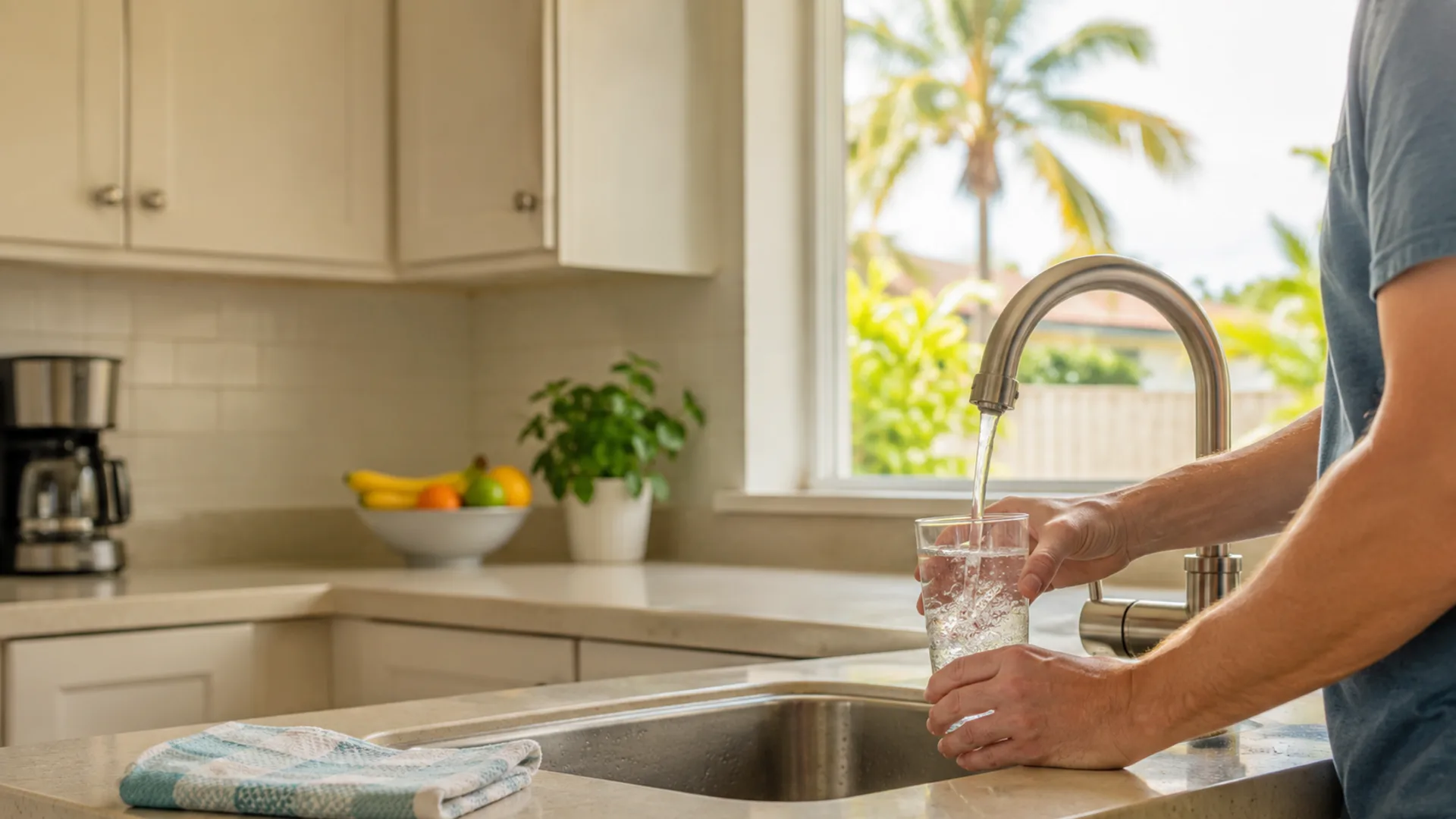
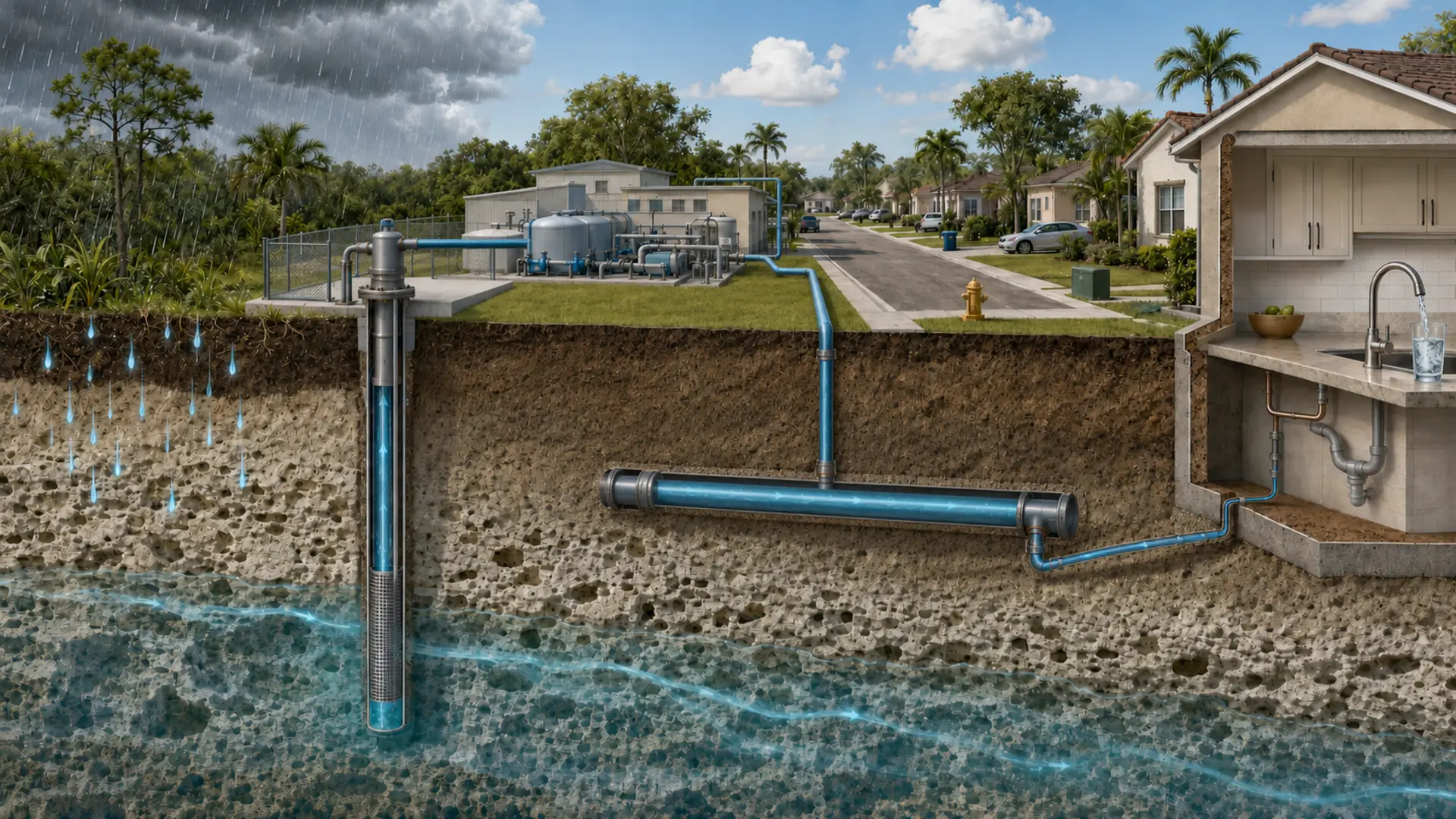
Long before Florida had cities, highways or millions of homes, rainwater was moving through the limestone beneath the peninsula. It fed springs, wetlands and vast underground aquifers. Today, much of the water Floridians use still begins below their feet.
What happens next is one of modern life’s quiet achievements. Water is pumped from its source, treated, disinfected, tested and sent through miles of pipe. Seconds after turning a faucet, a Florida family can fill a glass with water that may have traveled through an aquifer, a treatment plant, a public distribution system and the plumbing inside the property.
That last part matters. The utility’s report tells you about the public water system. Your faucet is the end of a longer journey.
So, is Florida tap water safe to drink?
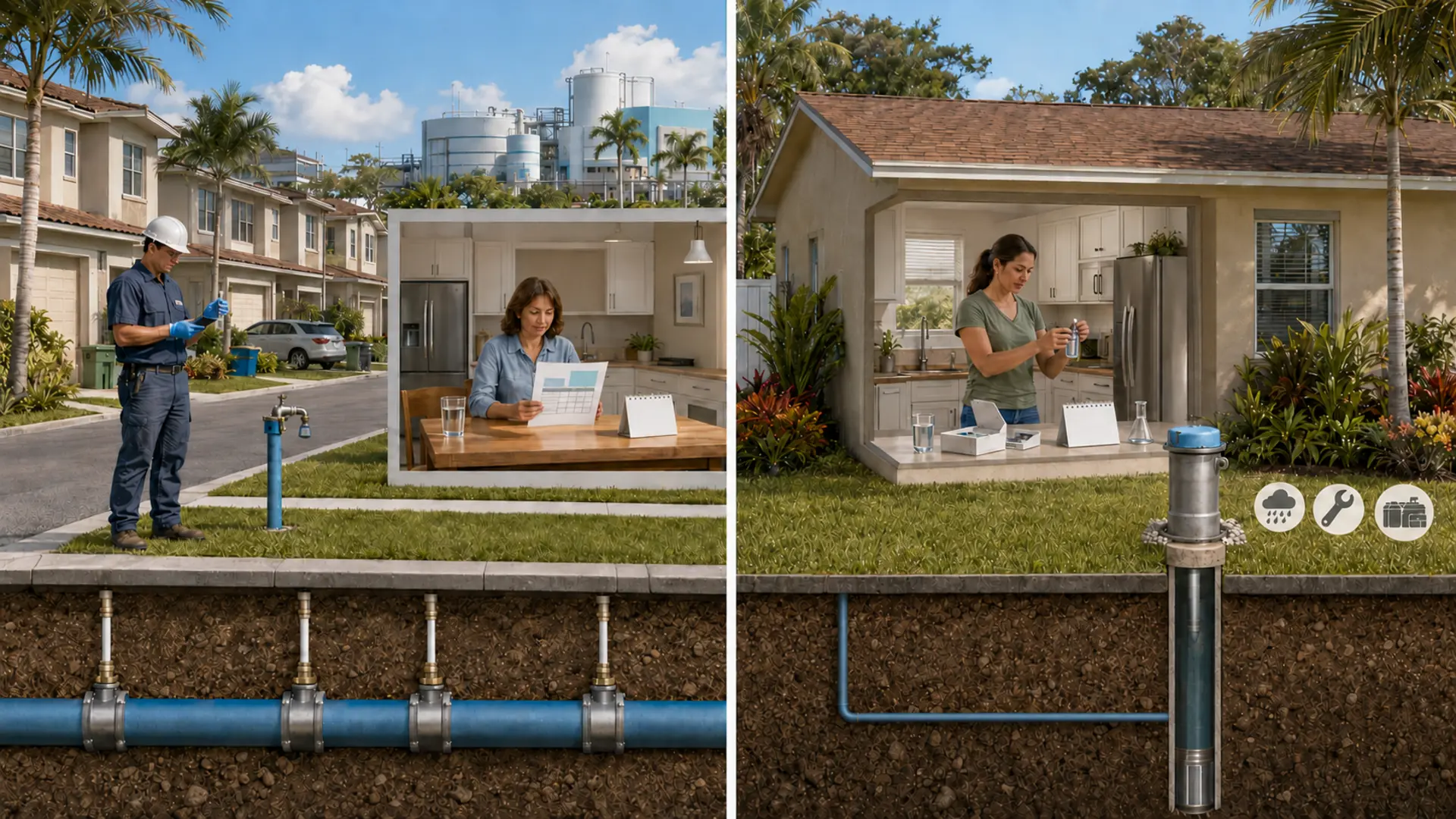
The short answer: Florida’s public drinking water systems are regulated and routinely monitored. Water that meets federal and state standards is generally considered safe to drink. But water quality is not identical in every Florida city—or at every faucet. It can vary with the source, treatment process, local distribution system, service line and plumbing inside the property. Private wells require a different level of personal responsibility because the owner, not a public utility, is responsible for testing the water.
This guide will help you understand what official reports can tell you, what they cannot tell you and how to make a sensible decision without fear or guesswork.
Where Does Florida’s Tap Water Come From?
Florida relies heavily on groundwater stored in aquifers. Depending on location, a community may draw from the Floridan aquifer system, the Biscayne aquifer or another local source. Some utilities use surface water or a combination of sources.
In Miami-Dade County, the Biscayne aquifer is the principal source of drinking water. It lies close to the surface and is replenished by rainfall. Water utilities treat the raw water according to its characteristics before moving it into the distribution system.
Treatment can include aeration, filtration, softening, corrosion control and disinfection. The exact sequence differs by utility and source. Disinfection is particularly important because it controls disease-causing microorganisms and helps protect water as it travels through the system.
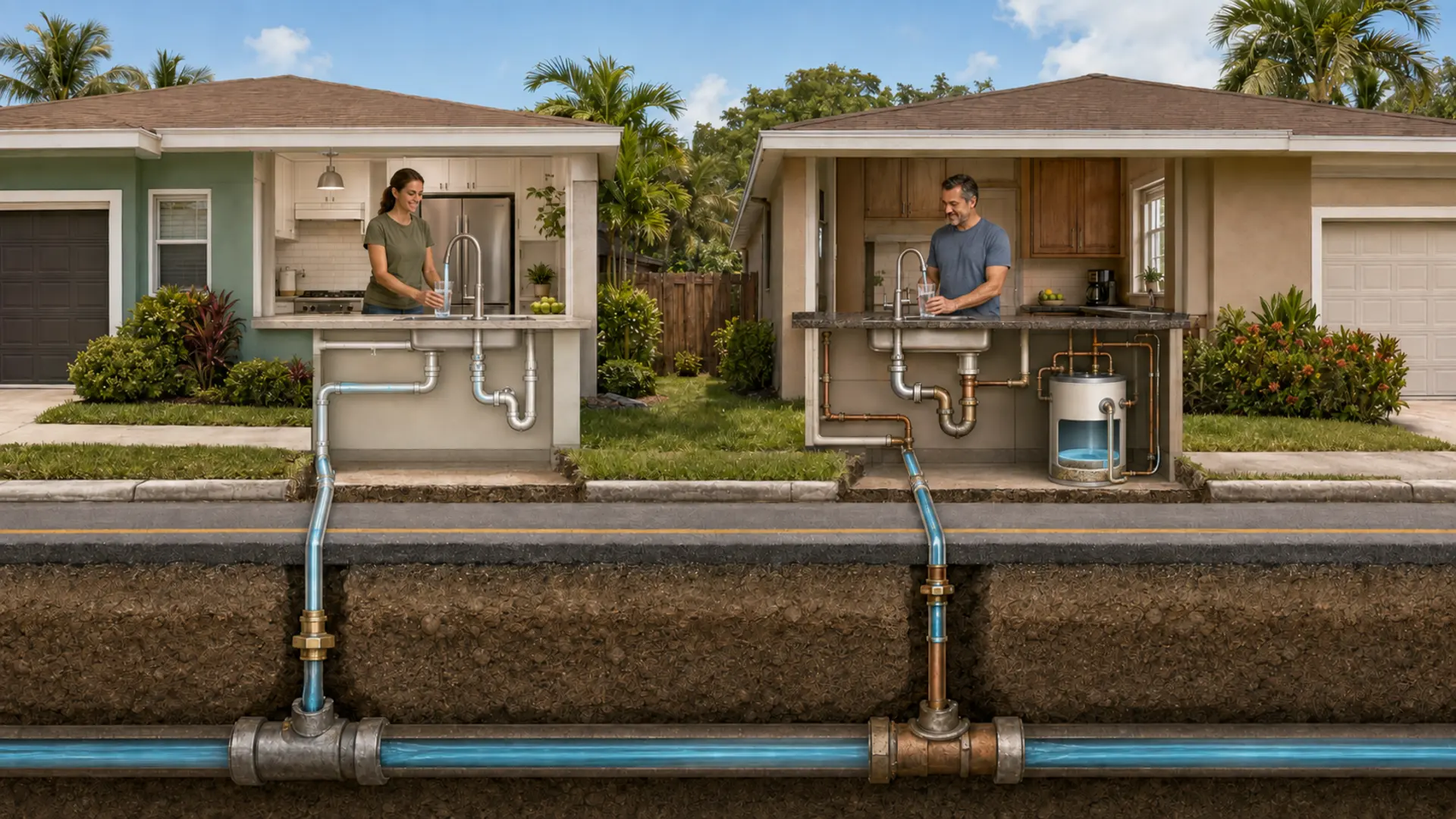
The journey, however, does not end at the treatment plant. Public mains, service lines, building plumbing, water heaters, fixtures and poorly maintained filters can all affect water before it reaches the glass.
That is why two neighbors served by the same utility can notice different taste, odor or appearance—and why a utility report and a properly collected tap-water test answer related but different questions.
What Florida’s Official Drinking Water Reports Actually Show
Florida’s Department of Environmental Protection publishes an annual compliance report for public water systems. The most recent statewide report available for this article covers calendar year 2024 and was published in August 2025.
The report recorded 15,888 violations across 4,965 active public water systems. That number sounds alarming without context. The state explains that the overwhelming majority were administrative violations, such as missed monitoring, reporting or public-notification requirements. They should not be described as 15,888 contamination events.
This distinction is essential:
- A monitoring or reporting violation may mean a required sample was not collected or reported correctly or on time.
- A maximum contaminant level violation means a regulated limit was exceeded under the applicable compliance calculation.
- A treatment-technique violation means a required treatment process or performance standard was not met.
- A detection simply means a substance was measured; it does not automatically mean the result exceeded a health-based legal limit.
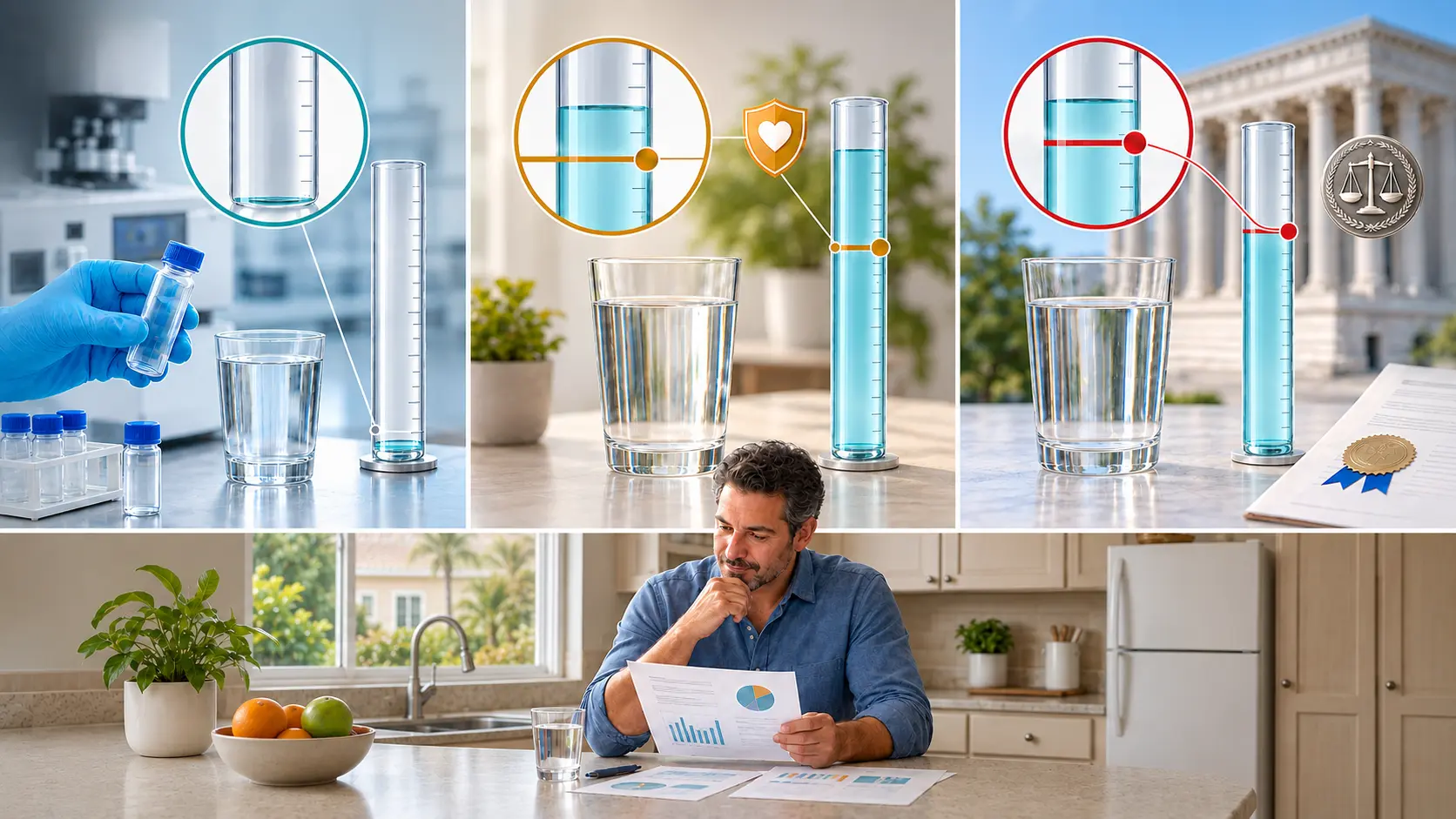
A third concept also matters: a health advisory, guideline or screening level can provide useful health context, but it is not automatically an enforceable drinking-water standard. A result may be detectable, may exceed a nonbinding guideline or may violate a legally enforceable limit; those are three different statements. Responsible interpretation identifies the benchmark, the sampling method and the rule that applies before describing a result as unsafe or noncompliant.
Numbers become useful only when we ask: What substance was involved? At what concentration? What rule applied? Which water system was affected? What corrective action followed?
For a statewide overview, consult the Florida DEP 2024 Annual Compliance Report. For decisions about your own home, begin with the report for your exact utility.
Common Concerns About Florida Tap Water
Disinfection byproducts: TTHMs and HAA5
Disinfection protects public health, but disinfectants can react with naturally occurring organic material in source water. That reaction can create disinfection byproducts, including total trihalomethanes (TTHMs) and five regulated haloacetic acids (HAA5).
The federal maximum contaminant level is 0.080 mg/L for TTHMs and 0.060 mg/L for HAA5. Florida’s 2024 report recorded 100 TTHM maximum-contaminant-level violations affecting 27 systems and 49 HAA5 violations affecting 21 systems.
These figures do not mean all Florida water exceeded these limits. They show why statewide headlines are less useful than the report for the system that serves your address.
The practical lesson is not that chlorine is “bad.” Disinfection prevents serious microbial risks. The technical challenge is to maintain effective disinfection while controlling byproduct formation.
Lead can enter water after treatment
Lead is different from many source-water contaminants because it can enter drinking water through corrosion of service lines, solder, fixtures and plumbing materials. A utility can deliver compliant water while a particular property still deserves closer examination.
You cannot see, smell or taste lead in water. Boiling does not remove it and can increase its concentration as water evaporates. If lead is a concern, use cold water for drinking and cooking, have the water tested correctly and select only a filter certified for the specific reduction claim.
The age of a property can help identify risk, but age alone does not prove that lead is present. Testing is what turns concern into evidence.
PFAS, or “forever chemicals”
PFAS are a large group of synthetic chemicals that can persist in the environment for long periods. In 2024, the EPA established enforceable drinking-water standards for six PFAS, including maximum contaminant levels of 4 parts per trillion for PFOA and PFOS. As of August 12, 2026, those standards remain in effect.
The EPA has proposed allowing eligible public water systems to request up to two additional years—until 2031—to comply with the PFOA and PFOS limits. Systems that do not receive an extension would remain subject to the original 2029 deadline. The agency has also proposed rescinding the current regulations for PFHxS, PFNA, HFPO-DA—commonly called GenX—and the related Hazard Index mixture. Both actions remain proposed and have not yet become final rules.
PFAS cannot be identified by taste, odor or appearance. Because regulation and treatment claims continue to evolve, homeowners should review their current local water-quality report and verify that any treatment system is independently certified for the specific PFAS reduction claimed—not rely on broad language such as “advanced purification.”
Nitrates and microbial contamination
Nitrate can enter groundwater from fertilizers, septic systems, animal waste and other sources. The drinking-water limit is 10 mg/L measured as nitrogen. Florida’s 2024 report recorded five maximum-contaminant-level violations affecting four public systems.
Nitrate is especially important in households with infants, and it cannot be diagnosed by looking at or tasting the water.
Coliform bacteria are commonly used as indicators of treatment and distribution-system integrity. Most coliforms are not themselves harmful, but certain results can signal conditions requiring immediate attention. Florida’s 2024 report identified five public systems with acute violations involving fecal coliform or E. coli.
If your utility or health department issues a boil-water notice, follow the notice exactly until the authority lifts it. A household filter does not replace public-health instructions during an emergency.
Chlorine taste, sulfur-like odor and discoloration
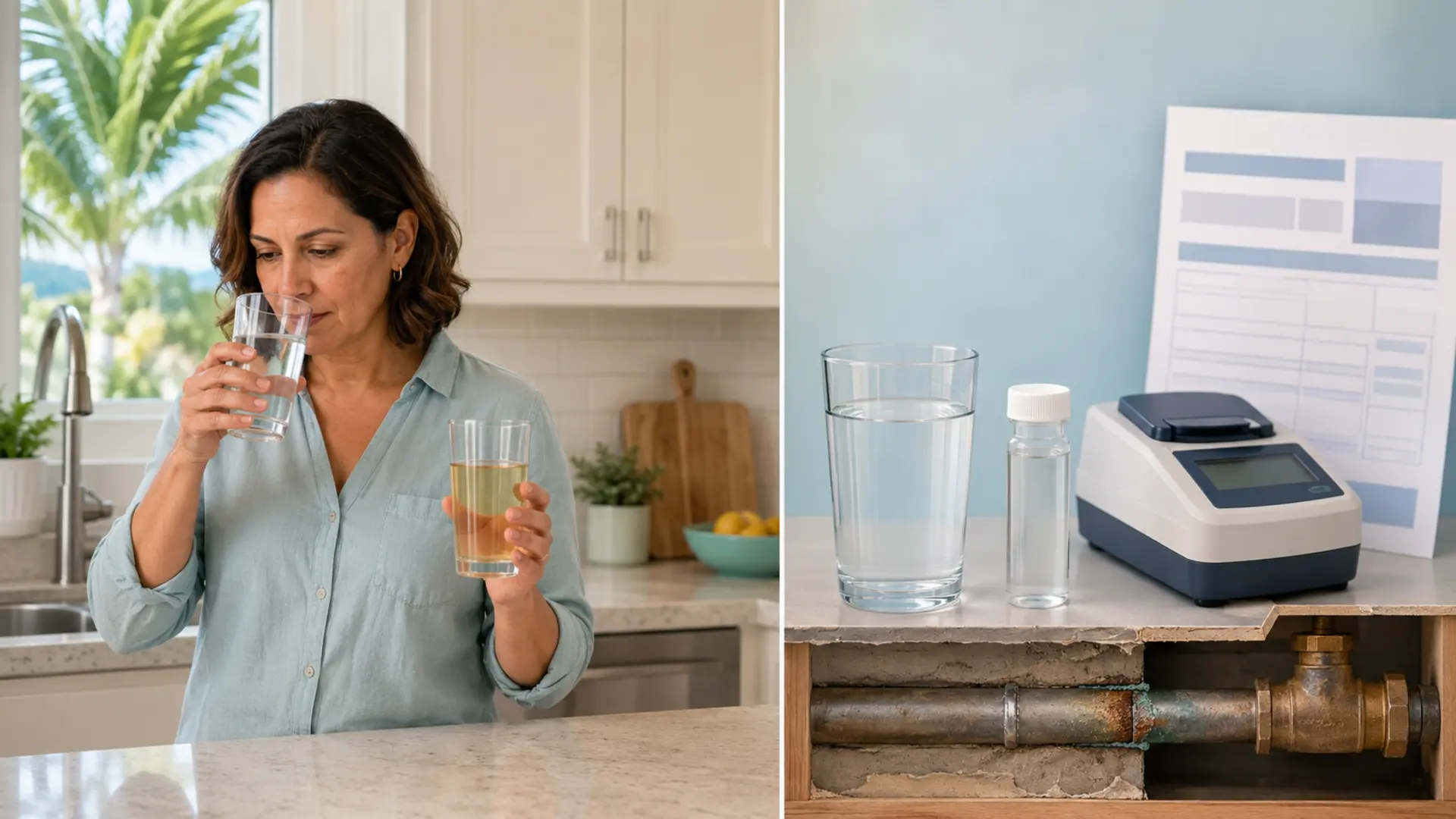
An unpleasant taste, smell or color does not automatically prove that the water is unsafe—but it should not be dismissed.
A chlorine taste or odor may reflect the disinfectant residual used to protect water in the distribution system. A rotten-egg smell can be associated with hydrogen sulfide in some well-water situations or with conditions inside a water heater. Yellow, brown or reddish water can be related to sediment, iron, corrosion or temporary disturbance in the distribution system.
The useful questions are:
- Is the issue present in hot water, cold water or both?
- Does it occur at one faucet or throughout the property?
- Did it begin after nearby utility work, a plumbing repair or a period of low use?
- Are neighbors noticing the same thing?
If the change is sudden, persistent or accompanied by an official advisory, contact the utility or local health authority before assuming that a filter is the answer.
Why Water Quality Can Change Between the Treatment Plant and Your Faucet
Think of drinking water as a chain:
source → treatment plant → public main → service line → building plumbing → fixture → glass
The utility controls and monitors much of that chain, but not every component inside a private property. Water can interact with pipe materials, solder, fixtures and stagnant sections of plumbing. A water heater can introduce its own odor or sediment issues. A cartridge that is not replaced on schedule can lose performance and may create a maintenance problem of its own.
This is not a reason to distrust every faucet. It is a reason to choose the right evidence for the right question:
- The Consumer Confidence Report describes the public system’s source, detected contaminants, regulatory comparisons and violations.
- A properly collected laboratory sample can investigate a concern at a particular faucet or private well.
- A plumbing inspection can help locate problems within the property.
One document or test should not be asked to answer all three questions.
How to Find and Read Your Local Water Quality Report
Community water systems issue an annual Consumer Confidence Report, often called a water quality report. The EPA requires these reports to explain where the water comes from, which regulated contaminants were detected, how results compare with standards and whether violations occurred.
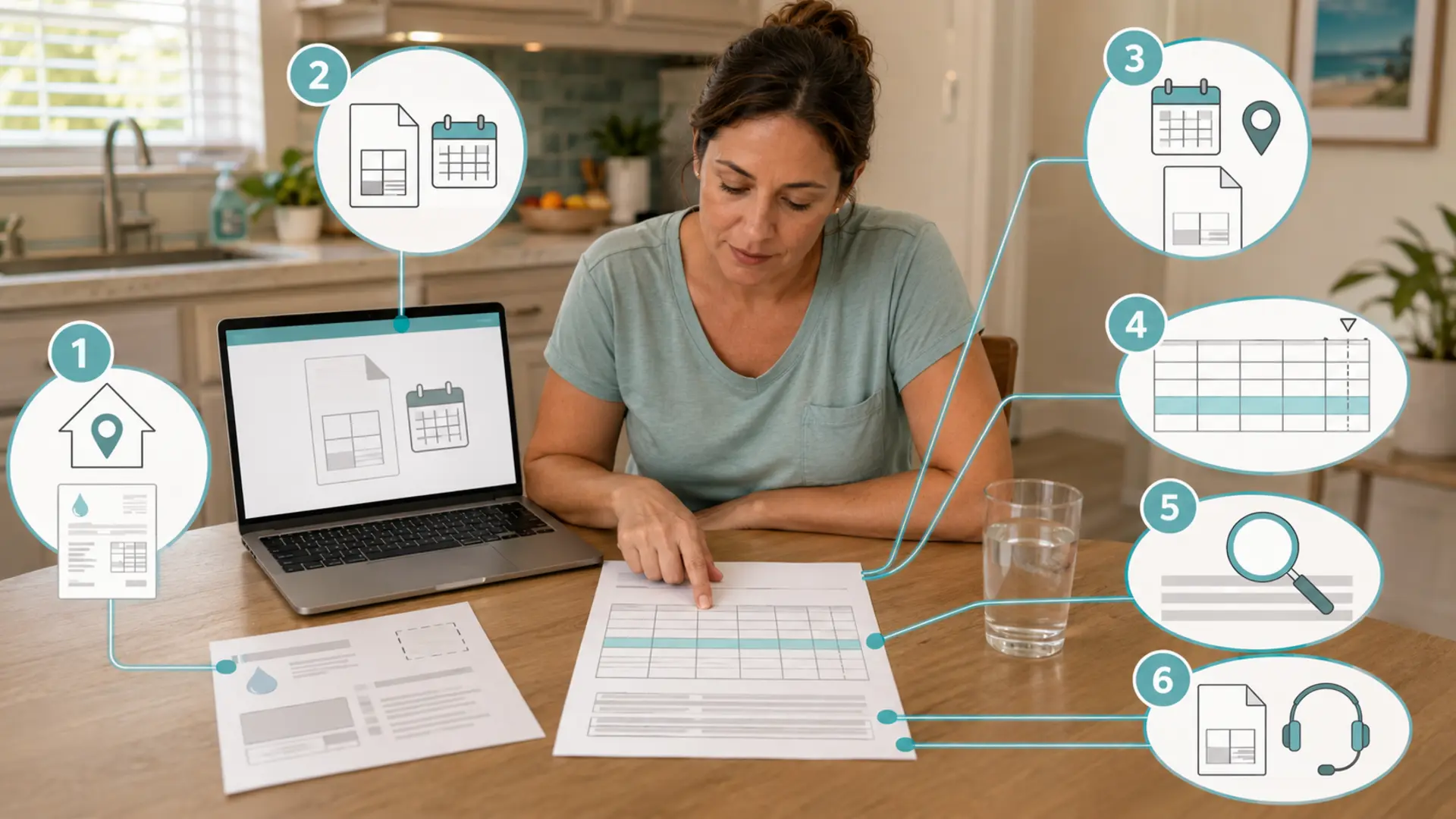
Use this six-step check:
- Identify your exact water provider. Your city name and utility name are not always the same.
- Find the latest report. Search the provider’s name plus “Consumer Confidence Report” or use the EPA CCR resource.
- Confirm the reporting year and system. Do not assume a neighboring city’s report applies to your address.
- Read the detected-contaminants table. Compare the result or range with the MCL, action level or other benchmark shown in the report.
- Read the footnotes. They explain sampling dates, averages, violations and corrective actions.
- Contact the provider when something is unclear. A report should inform a decision, not leave you interpreting abbreviations alone.
Miami-Dade’s Water and Sewer Department released its 2025 Water Quality Report in April 2026. The county says it performs more than 150,000 samples and tests each year throughout treatment and distribution and that its drinking water meets applicable local, state and federal standards. That is meaningful evidence about the county system. It is not a laboratory result from every individual kitchen faucet.
Municipal Water and Private Wells Require Different Decisions
If a public utility serves your home, the utility performs required monitoring and reports the results. If your home uses a private well, the owner is responsible for maintaining the well and testing the water.
The CDC recommends testing private wells at least annually for total coliform bacteria, nitrates, total dissolved solids and pH, with additional testing based on local conditions and nearby land use. Florida health authorities particularly emphasize routine testing for bacteria and nitrate.
Test sooner when:
- Floodwater may have entered the well.
- The well was repaired or disinfected.
- Taste, odor or color changed.
- A septic-system problem occurred.
- A nearby spill, agricultural activity or construction creates a new concern.
- Someone in the household is pregnant, is an infant or has a health condition that makes water quality especially important.
Use a certified laboratory and follow its sampling instructions. A poorly collected sample can produce a misleading result.
Should You Filter Florida Tap Water?
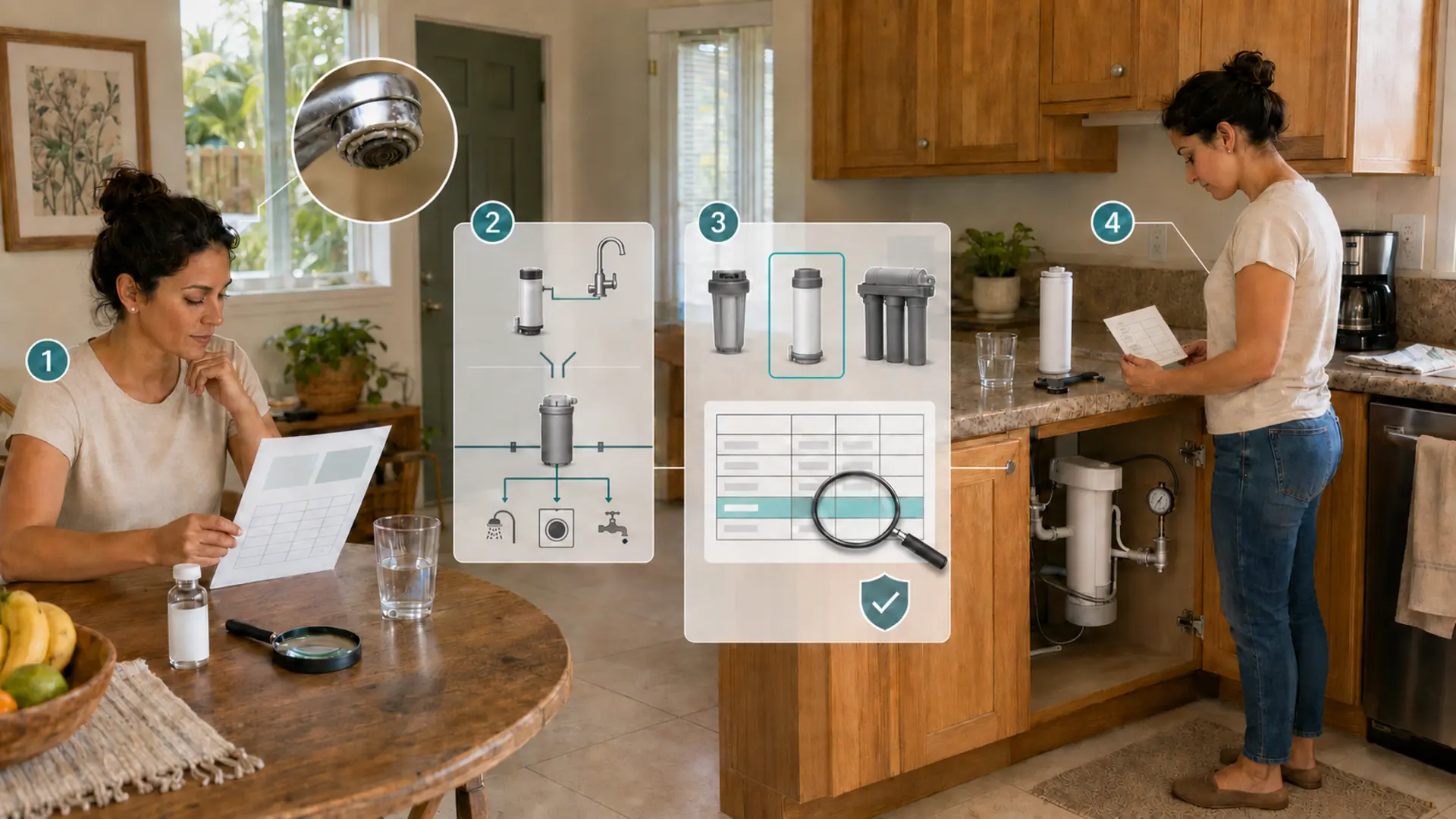
Not every household needs the same treatment, and no responsible recommendation should begin with a product.
Start with the problem:
- Are you trying to improve taste or odor?
- Are you concerned about a contaminant identified in a report or test?
- Are hardness and scale damaging fixtures and appliances?
- Do you use a private well?
- Do you want treatment at one drinking-water faucet or throughout the property?
Then match the technology and certification to the concern.
| Concern | First step | Possible treatment approach* |
|---|---|---|
| Chlorine taste or odor | Review report and confirm the issue | Activated carbon |
| Lead | Test at the tap and inspect plumbing risk | Device certified for lead reduction |
| PFAS | Review local data or obtain an appropriate test | Certified carbon or reverse-osmosis device with the specific PFAS claim |
| Hardness and scale | Hardness test | Water softener |
| Nitrate | Laboratory test | Technology specifically certified or validated for nitrate reduction |
| Private-well contamination | Comprehensive laboratory analysis | Treatment designed from the results |
| Microbial emergency | Follow health-authority instructions | Appropriate disinfection; do not rely on a generic filter |
*Treatment selection depends on the result, the property, system capacity, certification, installation and maintenance.
NSF/ANSI standards can help clarify what a product is designed to do. Standard 42 commonly covers aesthetic effects such as chlorine taste and odor. Standard 53 includes specific health-effect reduction claims. Standard 58 applies to reverse-osmosis systems. A standard number alone is not enough: confirm the exact model and the exact contaminant reduction listed in its certification.
Also consider ownership after installation. Replacement filters, sanitization, service intervals, water pressure and total operating cost matter. A sophisticated system that is not maintained is not a long-term solution.
Frequently Asked Questions
Can you drink tap water in Florida?
Water from a Florida public system that meets federal and state requirements is generally considered safe to drink. Check your utility’s current Consumer Confidence Report and any active advisories. Private-well owners need their own testing program.
Is Miami tap water safe to drink?
Miami-Dade reports that its drinking water meets applicable regulatory standards and that it conducts more than 150,000 samples and tests annually. Households with a specific concern—especially involving internal plumbing—may still choose to investigate the water at the faucet.
Why does Florida tap water smell like chlorine?
Utilities use disinfectants to control microorganisms in the distribution system. A noticeable residual does not by itself mean the water is unsafe. If the odor is new, unusually strong or accompanied by another change, contact the utility.
Does boiling water remove lead or PFAS?
No. Boiling is useful when authorities instruct residents to address microbial contamination, but it does not remove lead or PFAS and may concentrate some nonvolatile contaminants as water evaporates.
Is bottled water always safer than tap water?
No. Bottled water and public tap water are regulated under different systems, and bottled water is not automatically superior. The better comparison depends on the specific source, test results, storage and intended use.
How can I test my home’s water?
Begin with your utility report. For a specific concern, contact the utility, local health department or a certified laboratory. Tell the laboratory what you are investigating so it can recommend the right test and sampling method.
What certification should I look for in a water filter?
Look for independent certification of the exact model for the exact contaminant or performance claim you need. Do not assume every carbon or reverse-osmosis system has the same certified capabilities.
Your Water Story Starts at Your Faucet
Florida’s drinking-water story is not a simple choice between “safe” and “unsafe.” Public treatment and monitoring provide an essential layer of protection. Local sources, distribution systems and private plumbing explain why the experience can still vary from one community—or one home—to another.
The sensible path is straightforward: identify your provider, read the latest report, test when there is a specific reason and select treatment only after defining the problem.
At Alkaline Water US, we believe a responsible recommendation should begin with your water and your property—not with the system someone wants to sell you.
What Is Your Florida Water Story?
- What city do you live in, and what have you noticed about your water’s taste, odor, hardness or appearance?
- Have you ever read your utility’s annual water quality report?
Share your experience in the comments. Your question may help us build the next practical guide for another Florida family.
Official sources
- Florida DEP: 2024 Annual Compliance Report
- EPA: Consumer Confidence Reports
- Miami-Dade: 2025 Water Quality Report announcement
- Miami-Dade: Water Supply and Treatment
- CDC: Guidelines for Testing Well Water
- CDC: About Choosing Home Water Filters
- EPA: Basic Information about Lead in Drinking Water
- EPA: PFAS Drinking Water Regulation
- Florida Department of Health: Private Well Water Testing
- NSF: Standards for Water Treatment Systems